The Fall Season
 The digital innovations that Peter Gelb has launched this season (plans for multiplex simulcasts of a handful of Saturday afternoons, Sirius satellite broadcasts of four performances per week, beginning tomorrow) seem at first blush revolutionary, but taken in the larger context, are mere incarnations of the story of opera’s migration out of the opera house, begun about a century ago. Before the era of recorded music, opera belonged firmly within the gilded walls of the opera house, locked in time, dead by curtain’s fall. Then it became a thing (a cylinder), and morphed into other things (a record, tape, laserdisc, CD, DVD, mp3, YouTube), made immortal, and a thing to own, private and portable. These days, it lives in my hard disks, my video iPod, the FM airwaves, in the ether of the net, and very shortly, at the mall and circling in outer space. Apart from the changed landscape of the economics of opera distribution (from the megacorporations down to the mom-and-pop pirates of family circle), nothing else of the essence has been altered. The many refractions of opera have been in distribution since before yo mama was born, so Sieglinde just has to get with it. (And she got Sirius today; more later.)
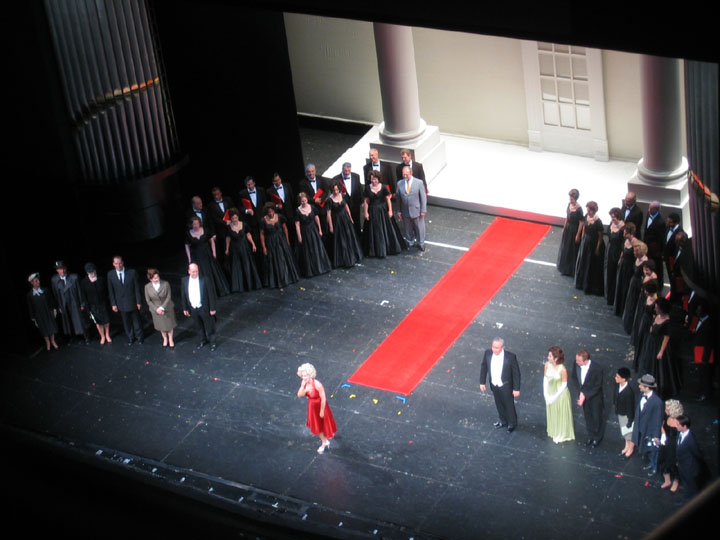
The Met is large enough, singers great enough, and die-hard fans die hard enough, to withstand the relentless packaging of the Met’s magic as readily consumable items for the pop aisle. This is my better hope. The paradox, however, is that it is the Met footprint’s sheer size that makes its every stomp register decisively in the wider world’s cultural Richter scale. All the talk about “opera as a whole theatrical experience” to me is code for things like: (a) Deborah Voigt’s gastric bypass being, in hindsight, genius, and Jane Eaglen born a generation later would have little chance of cultivating the Met career she had; (b) more Kristin Chenoweth, less Soile Isokoski; (c) regietheater of an American sort (i.e., corner of Broadway and Hollywood), etc. etc. (Interestingly, Renee Fleming, ever durable, fits both models.) We’ll see how hard Peter the Great will push; I'm deeply suspicious and regrettably skeptical. Meanwhile, the red carpet, Liz Smith, Times Square: the marketing of opera as social currency, beyond the power of the notes and the words, is a kind of a return to opera’s former self. Glamour and intrigue, made accessible to a casual public, craving headlines, so ready for any form of mutation and consumption. If there ever was a golden age of opera, opera as the realm of the voice above all else, it may have been what we just had.