14 November 2005

Guillaume Tell

Rossini GUILLAUME TELL, Opera Orchestra of New York at Carnegie Hall, 13.11.2005; c. Queler; Blasi, Giordani, Chingari.

[UPDATED BELOW.]
[SCOTTO/MILLO PIC UPDATED: Many thanks to Leyla, Sieglinde's personal archivist.]

The night before, I decided I wasn't going to the OONY Guillaume Tell. I'm tired. I'm poor.

Forty-five minutes to curtain, I get a three text messages: (1) "Zaza is here she needs a ticket"; (2) "Scotto is n da lobby"; and (3) "Everyone here you crazy". I cave in. Therefore: quick Chinese dinner; rush to Carnegie Hall; grab front balcony ticket from scalping gentleman for $15 (score!); take crummy seat; switch seats during first intermission for a better view of the last two prima prima donnas. (I know, worthless pic; but I was far and it was dark; gimme a f* break, puhleeze...) But here are Renata Scotto (left) and Aprile Millo, seated in the center box, first tier, chatting about Marcello Giordani during the second intermission. Or about the Zazà of a lifetime (Millo asks: "Why you not come to the Zazà? Licia was there, why you not?"). Or maybe just about the best penne carbonara in Lower Manhattan.


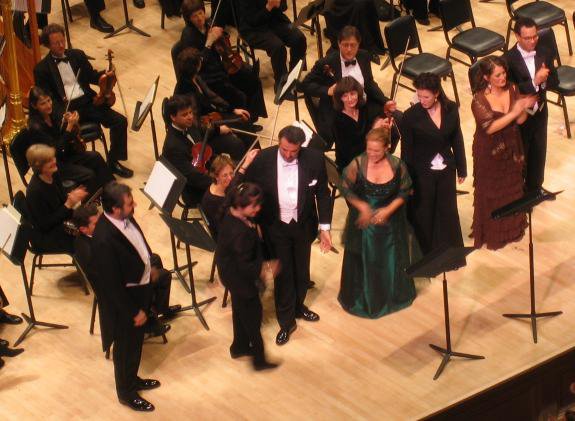
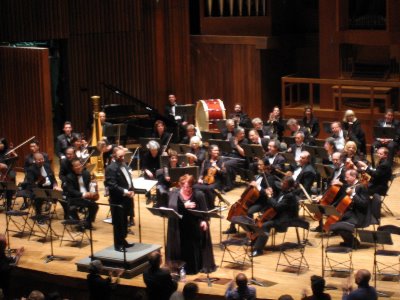
I'm exhausted; no more words. Sieglinde gives the bottom line: Marcello Giordani is the reigning admiral of the High Cs; to have that kind of balls to bis Arnold's Act IV vengeance cabaletta "Amis, secondez ma vengeance" after 11pm: BRAVO DIVO! I've not heard pandemonium like this in a long while. Below, Eve Queler's curtain call, surrounded by the principal cast. (Angela Maria Blasi is in green.)

But wait. Before I collapse, I leave you with a zoom of the best pic I was able to take of Stephen Costello, in case you're interested. (Yet another crappy pic. Whatevah.) He has a light, easy tenor: luxurious in the cute role of the Pechéur. He can sing! All he needs now is a centerfold in Opera News.

GOOD NIGHT.

UPDATE [the following morning]: I'm up. A few more impressions before I rinse Guillaume Tell off my ears with Roméo et Juliette, this evening's French buffet at the Met. Steve Smith summarizes the Hall's hysterical adulation for Marcello Giordani here (not since Semele ... haha!): an electrifying standing ovation (including La Scotto, La Millo, and La Kirschenbaum) after the cabaletta; then, Giordani whispers to Eve Queler, index finger raised, which I thought at first meant "Gimme a second to catch my breath," but soon becomes clear to me as a sign for "Let's do that f* thing again" when La Queler and orchestra start flipping their scores back a few pages. During the bis of the second stanza of the cabaletta (with the pumped chorus on his back), I tell myself "This guy is nuts, he's surely gonna do damage to that voice." But what a generous, joyful artist! Kammersängerin Angela Maria Blasi essays an attractive Mathilde; this is Sieglinde's first Blasi hearing; highly expressive, technically unblemished, she pings a la Cheryl Studer, like the smooth, round bottom of a fine porcelain bowl. Eve Queler, we all love her!, but that Overture is how a computer, taught the values of notes and pitch, would play it. The basic (sleepwalking) temperament of the orchestra never changes through the evening, but that's hardly a surprise. We go (and return and return) to OONY events to revel in the voices, which always fill in the missing blood and guts: this evening the voices deliver once again.
13 November 2005

Degrees of Despair, Memorable

Leoncavallo ZAZÀ; Teatro Grattacielo at Alice Tully, 12.11.2005; c. Silipigni; Millo, Powers, Gartner, Grunewald, Monaghan, Yoon.

Aprile Millo's Zazà is a supernatural achievement. In a career of countless landmarks, this may be the greatest yet. She was announced as just coming out of illness, which explained a frightening Act I, marked by fat vibrato during do-or-die leaps in the upper registers, and her alarming gargly coughs between acts. But by Act III, the meat of the soprano's work, and through the inevitable fall in Act IV, Millo overcomes biology and delivers the exact verismo animus. While both constitutionally melodramatic, there are two approaches to doing verismo: one is to come from elegance and post-romantic style (Tebaldi), and the other from base, filthy, almost subhuman crevices (Olivero). I dare say Millo, miraculous, takes both approaches without trickery, and shows that tonal beauty can actually thrive in hard incongruence. Highly histrionic for sure, but only as much as Leoncavallo wrote in. For this Zazà, Millo didn't need the grand stage of an opera house, towering sets, costumes and hair (though she came out with a number; another story for another time), complete choruses, competent costars and orchestra; she didn't need supertitles, Met titles, or libretto books: from her endearing pantomime, to her flawless articulation of the many layers of pain and happiness, a sure Italian stand, and that voice, unmistakable echo of past giants, Millo does art to make sense of all the excesses of verismo. She makes us believe. I don't need to say that I'm a fan of the Aprile, but only as far as she meets minimum requirements of music and taste: Sieglinde will maneuver to emphasize the little jewels over the rot any time for her: however, what I have seen at Alice Tully Hall this evening is a performance of a lifetime, by a sensitive worker, sadly fragmented by time and age, still fighting for a true place. Her sobs and cries alone can give masterclasses to the premiere roster of the Metropolitan: the density of shading of these sonic outbursts has more fire, more story than any other diva's 'Amami, Alfredo' or Liebestod: the range of despair explored by Millo's final sounds others can only dream of in their tedious lifetime of singing. And these were just the sobs! For those who weren't there, a 'transcription' of this historic evening will surely surface; rejoice; hear to believe; the operatic legacy is once again enriched by Aprile Millo immeasurably.

12 November 2005

Roll Call


NICK IN LOVE: "I am inclined to think that she might know about the lighter, headier tones of Love itself and stir those into her brew, instead of being outright witchy. One gets the sense that, with Fleming, Armida is levitating by way of her own vocal magic." [SIEGLINDE: Love the new look and feel of trrill, btw!]

VILAINE FILLE ON VOCAL GEOGRAPHY: "Frittoli's growing flutter is troublesome in this music. But it's a flutter through periwinkle silk, shaded with gunmetal grey and shimmering with peachy-gold and pearls. (Though Frittoli is from Milano, her timbre makes me *see* Venezia.)" [SIEGLINDE: This is how you write about voice.]

A & J ON RENAMING FAMILY CIRCLE: "J: Po' People Pavillion?; A: 'Single Guys and Cheap Tourists'; J: seriously tho who can we talk to about this?; J: I think 'Upper Balcony' would be lovely; J: 'Rear Balcony'; J: 'The Sky' " [SIEGLINDE: How about "Celestia" or "Inferno, 7th Circle, Inner Ring" or simply "Blog Level".]

STEVE SMITH ON LHL NYT RUMORS
: "[T]o what end should speculation be allowed to virtually substantiate rumor? What role should an individual's right to privacy play in determining whether a story like this one should be reported to a broad public -- many of whom will most likely accept what the article suggests as truth, simply based on where it appeared? And why, lacking hard facts, should this particular story be spun this particular way in print, when in the case of any number of other famous artists -- one cult-favorite pianist in particular -- constant cancellation has been spun as jitters, even caprice?" [SIEGLINDE: Uses OONY Guillaume Tell money for soon-to-be-sold-out BSO/LHL concert at Carnegie Hall instead. Wooops, is Sieglinde really missing the Tell and the boy? She needs a sugar daddy.]

M.C- ON SOPORIFIC SF NORMA: "Anyway, we had Catherine Nagelstad as Norma, Irina Mishura as Adalgisa, and Zoran Todorovich as Pollione. They were all fine, I suppose. If you judge them as Nick does, sing or suck, yea or nay, I would have to say they sucked." [SIEGLINDE: Renée to the rescue! In a titillating coincidence, Met Norma is back on Brad's futures list for 2007-08. Long shot, but so what.]

OT: WONKETTE ON BUSHIT: "In a Veteran's Day speech today, Bush came out with the administration's official policy on criticizing the war in Iraq: 'While it's perfectly legitimate to criticize my decision or the conduct of the war, it is deeply irresponsible to rewrite the history of how that war began.' Because, he continued, 'That's our job.' " [SIEGLINDE: If you're not reading Wonkette, I don't want to know you.]

10 November 2005

Deborah Voigt


Deborah Voigt and Ben Heppner, Lincoln Center presents Great Performers; Avery Fisher Hall, 9.11.2005; c. Fisch, Orchestra of St. Luke's.

So she's moving, cautiously, into deeper Wagner. In two seasons, New York will see her Isolde, and a year later as all the Brünnhildes of the Ring. The voice has really not changed since I first heard her many, many years ago: essentially the same bright, joyous sound that thrives in high tessitura, but solid from top to bottom (a well-integrated chest), enduring the ups and downs of weight loss and gastric bypass, as well as a formidable repertory of Strauss and Wagner-lite. The evening at Avery Fisher Hall presents her Isolde and high Brünnhilde, in duet with the magnificent Ben Heppner, plus the more familiar Elisabeth ('Dich, teure Halle') and Leonore ('Abscheulicher, wo eilst du hin?'). Though starkly different in heft, quality, and repertoire, Leontyne Price is how her artistry reaches me: distinctively American, their voices are relentless in pure, heavenly happiness: Leontyne is the chorus of angels, Deborah is the mighty wind that carries their wings. The stubborn optimism and gratefulness in their voices (of the Ella Fitzgerald camp, as opposed to Billie Holiday), which in some quarters is condemned as emotional monotonicity, works to their advantage in many great roles: in Voigt's case, her Sieglinde is ecstatic and metahuman; her Chrysothemis is the white-gold light peeking through the solid darkness of Elektra; her big-screen Ariadne is above it all; the Empress she imagines is a true floated goddess. (But let us never speak about her Italian repertoire.) In each of these roles, Voigt becomes a radiant pot of molten silver, and when their music escalates up and hangs out above the staff for lengthy periods, the silver shines, flows, and covers every pore of your skin.

But now we have Isolde and Brünnhilde, two of the more complex figures in the operatic literature. They can be essayed in simple (but magnificent) gestures and still end in success: for instance, Birgit Nilsson does a take-no-prisoners approach to these two roles and blows everyone away with her liquid laserbeam. Voigt does have Nilsson's notes but lacks the density (but who else doesn't) and the thrilling attack onto the note that takes my breath away every single time. I don't know if Voigt can still correct her little pop-song mannerism of ever so slightly sliding up into her top notes, instead of grabbing them solidly right from the first wave cycle of sound escaping her throat. (Varnay slid too, but hers was a more "classical", elegant plié.) Sieglinde advises: attack top notes head-on, Debbie; don't ornament like you're on Broadway. But these are minute concerns. Unfortunately, there remain two main areas that Voigt can't even fake: (1) manic , demented terror and (2) quiet desperation. (Some "singers" have loads of these, but horribly senza voce. We shall not name names here.) These two aspects of coloring are required in measured quantities by Isolde and Brünnhilde, and these might prove to be her Achilles heel. I heard Voigt's Act II Isolde in concert some seasons ago (NYPhil), and back then her reading was straightforward at best. In the interim, Thielemann's influence has appeared to soften and somehow deepen her interpretation, and in last evening's concert (Love duet from Act II), her journey, it seems, has taken her about as far as she's able to go. The first half of the duet settles in the quiet, introspective part of the voice, and here Voigt struggled to color and textualize (or musicize?) emotions other than a secret joy. However, she was splendid during the second half, the ecstatic high tessitura orgasm, where the silver of her instrument gleamed shamelessly. Brünnhilde's final duet from Siegfried, always a unique Olympian challenge (short but a killer of an evening), was better served, with well-enunciated trills and juiced top notes. Extrapolating to the other parts of the Brünnhilde Ring, I look forward to her Acts I and II of Götterdammerung, but will remain ambivalent about her Die Walküre. We shall see.

But a translucent, stupendous sound over-all, laced with goodness and honesty: a kind of glittering thing that thrills the fans of physics and vocal calisthenics. Voigt has flawless technique and ample natural gifts (and what breath control, despite the weight loss), and though she may never be able to change the essential quality of her bright, open, joyful timbre, crossing to legendary (in the heavy Wagner repertoire, as she has done unquestionably in the Strauss) may still be possible if she shifts her attention away from the written music momentarily, and, in awkward ways, loses herself in the queendomain of opera. (Let everything go, Debbie. I will still love you.)

If time allows, I'll speak about the mighty Ben Heppner and the horrid acoustics and atmosphere of Avery Fisher Hall in the coming days. The short of it: I've not heard Heppner in finer form, though of course the recital was tremendously shorter than Aeneas or Tristan. But the molten cream of his tenor, his ravishing phrasing, his full-throated top, all made grand achievements of the Wagner duets, the Act I aria from Der Freischutz, and the winner Walther's Prize Song from Die Meistersinger. Meanwhile, Avery Fisher Hall acoustics is frightening, and that building should be razed to the ground.